

Introduction
Tata’s Sierra nameplate made a strong comeback in 2025 as a modern midsize SUV that blends retro cues with contemporary design. Alongside petrol and diesel variants, Tata has confirmed plans for an all-electric Sierra — the Tata Sierra EV — positioned to bring long-range capability and premium features to a mainstream SUV package. The Sierra EV aims to sit below Tata’s Harrier EV in the brand’s EV ladder but above smaller city EVs, offering a mix of usable range, tech-rich equipment and optional all-wheel drive on higher trims. Several industry reports and Tata’s own pre-booking pages confirm the EV as part of the model family and outline likely battery and range choices.
This article explains what we know so far: design and cabin, battery and motor options, range expectations, charging, features (including ADAS), expected pricing and variants, real-world ownership considerations, and who should consider the Sierra EV.
Design and interior: modern retro reinterpreted
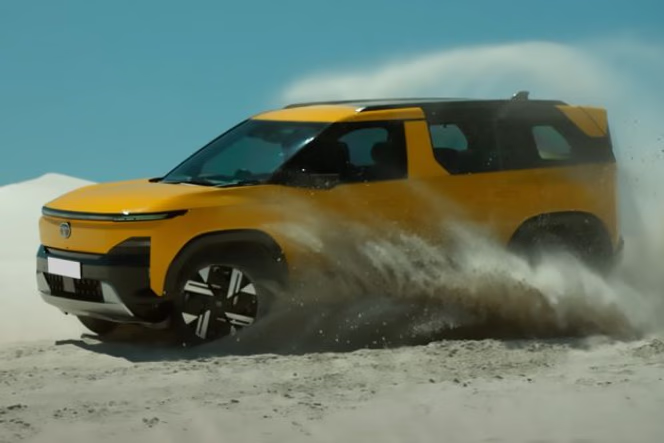
The production Sierra borrows the wraparound glass and strong proportions of the concept while adopting production-friendly details. The Sierra EV retains the upright SUV stance, short overhangs and the signature glasshouse that gives the cabin an airy feel. Production photos and early reviews show a clean front fascia with slim LED elements and a mostly closed grille — a typical EV visual cue — plus aero-optimized alloy wheels and squared wheel arches. Interior layouts follow Tata’s current design language: dual displays (instrument cluster + central touchscreen), a layered dashboard with soft-touch materials and usable storage. Expect features such as a panoramic roof and ventilated front seats on higher EV trims.
Powertrain, battery options and expected range
Tata’s strategy for the Sierra EV appears to mirror the Harrier EV approach: offer multiple battery-pack options and single-motor and dual-motor configurations to cover a broad buyer spectrum.
Key reported powertrain options
- Single-motor FWD variant with a smaller battery pack (estimated ~45–60 kWh).
- Mid-range single-motor variant with ~60 kWh pack (balanced range and cost).
- Dual-motor AWD top variant (65–75 kWh or higher) for higher power and range.
Published industry estimates put the Sierra EV’s real-world range in the 400–500 km band for the larger battery option; ARAI or company-certified numbers may be higher. Reported battery sizes and Harrier EV commonality suggest the Sierra EV could share a 60–75 kWh chemistry and liquid-cooling architecture that supports fast charging and sustained performance.
Table — Expected Sierra EV powertrain variants (indicative)
| Variant | Battery (kWh, estimated) | Motor | Drivetrain | Estimated WLTP/Real-World Range |
|---|---|---|---|---|
| Base FWD | 45 kWh | Single motor | FWD | 250–320 km (real world) |
| Mid FWD | 60 kWh | Single motor | FWD | 350–420 km (real world) |
| Top AWD | 65–75 kWh | Dual motor | AWD | 400–500+ km (real world) |
Note: These figures are compiled from multiple industry sources and Tata’s EV product strategy; final official specs should be taken from Tata’s product documentation at launch.
Charging and battery management
Early reports indicate the Sierra EV will support DC fast charging at competitive power levels (likely in the 100 kW class or higher for larger packs). Expect an AC home charger option (7.2 kW) for overnight charging and vehicle-side thermal management (liquid cooling) to maintain battery health and allow sustained fast charging sessions. Tata’s recent EVs have focused on practical charging curves that enable 10–80% fast charging in under an hour on larger packs — the Sierra EV is expected to follow that pattern.
Features and technology: what to expect
Tata positions the Sierra as a premium-but-attainable midsize SUV, so the EV will likely carry an elevated features list:
- Dual or triple digital screens (instrument + large central infotainment).
- Comprehensive connected-car features (Tata’s iRA suite) with remote controls, OTA updates and vehicle health diagnostics.
- Advanced HVAC and air filtration systems, panoramic sunroof and ventilated seats.
- Premium audio options on top variants.
Additionally, Tata is equipping its new launches with Level-2 driver assistance on higher trims; Sierra EV previews and reports specifically mention Level-2 ADAS (adaptive cruise, lane-keep, AEB and traffic sign recognition) and a 360° camera package for premium variants. Early reporting frames the Sierra EV as a tech-forward family SUV.
Safety and ADAS
Tata has strongly emphasised safety across its range in recent years, and Sierra EV is no exception. Expect a strong passive safety structure and a suite of active safety systems. The company’s models typically include multiple airbags, ESC, traction control, tyre-pressure monitoring and strong body integrity. Published previews and auto press indicate Level-2 ADAS functionality and 360° cameras as available or standard on higher grades — equipment that will be particularly valuable in a family-focused SUV.
Pricing and variants — what the market expects
Pricing for the Sierra EV has varied across industry sites; conservative and widely cited estimates place its ex-showroom starting price in the ₹15–25 lakh band depending on battery and variant selection. Some sources targeting a value play suggest entry-level EVs could be closer to ₹15–18 lakh, while AWD or dual-motor top trims may push toward ₹20–25 lakh (ex-showroom). Keep in mind that final pricing will depend on localization levels, battery capacity, tax incentives and regional EV subsidies.
Indicative price table (ex-showroom, estimated)
| Variant | Battery | Indicative Ex-Showroom Price (INR) |
|---|---|---|
| Base FWD | ~45 kWh | ₹15–18 lakh. |
| Mid FWD | ~60 kWh | ₹18–21 lakh. |
| Top AWD | 65–75 kWh | ₹21–25+ lakh. |
Use these as planning numbers — confirm final on-road pricing (including state EV incentives, registration and insurance) at your local Tata dealer.
Driving experience and performance expectations
Electric powertrains deliver instant torque and linear acceleration; the Sierra EV’s anticipated dual-motor AWD variant will be the sportiest, while the single-motor FWD variants will prioritise efficiency and everyday usability. Given Tata’s recent EV tuning (see Nexon EV and Harrier EV), expect composed ride quality, refined NVH and stable high-speed manners thanks to a low center of gravity from the battery layout. Off-the-line acceleration will feel brisk across trims; the AWD setup will add traction at the cost of slightly higher energy consumption.
Real-world ownership considerations
Running costs and charging
Electric running costs vary with local electricity tariffs and charging habits. Home charging at night is the cheapest option; fast public DC charging adds convenience at slightly higher per-kWh rates. Tata’s battery warranty policy and service network are important: Tata usually offers multi-year warranties for EV batteries and growing dealer support across the country, reducing range-anxiety and maintenance concerns.
Resale value and market position
EV resale values in India are still maturing. Models from manufacturers with strong support networks and proven battery longevity tend to hold value better. The Sierra EV, positioned against both ICE and EV competitors, will likely enjoy better resale if Tata provides strong battery warranties, software updates and nationwide service reach.
Competitors and market positioning
The Sierra EV will compete with compact-to-midsize EVs from established global and local players. Direct and indirect competitors include larger small-SUV EVs and upcoming models from Hyundai, MG, Mahindra and others. Tata’s advantage is platform commonality with proven EV siblings and a value-for-equipment approach; its challenge will be managing price expectations against competitors that may offer different battery/feature tradeoffs.
Who should buy the Sierra EV?
The Sierra EV is suited to buyers who want a practical family SUV with low running costs, modern tech and a meaningful electric driving range. If you regularly cover mixed commutes (city + highway), value ADAS safety, and have access to home charging — the Sierra EV becomes a compelling package. Buyers prioritising maximum range at all costs should opt for the largest battery variant; budget buyers should compare the entry EV against compact city EVs and factor in incentives.
Final verdict — strengths and cautions
Strengths
- Modern design with spacious cabin and Tata-style practicality.
- Multiple battery options and likely AWD on top trims give choice to buyers.
- Expected competitive charging and range figures that make intercity travel realistic for many owners.
- Tech- and safety-rich feature list with Level-2 ADAS on higher variants.
Cautions
- Final price and on-the-road costs will determine value versus rivals. Confirm incentives in your state.
- Real-world range depends heavily on driving style and climate; AWD variants will consume more energy.
- EV resale values are still evolving — long-term value depends on battery robustness and after-sales support.
Where to check official details and next steps
Tata Motors’ EV pages and the Sierra pre-booking portals are the best official sources for final specs, warranty details and pricing. Industry outlets and vehicle review sites will publish range and real-world tests once production Sierra EVs enter customer hands. If you’re considering a purchase, join waiting-list updates and compare local incentives to calculate precise on-road pricing.
Sources and further reading
Key sources used to compile this guide include Tata’s official Sierra materials and multiple reputable Indian auto publications that covered the Sierra launch and EV planning: Cardekho, CarWale, Hindustan Times, AutoCar India, Moneycontrol and Tata’s EV portal. For the most accurate live pricing and variant differentiation, consult Tata Motors or an authorised Tata dealer.